
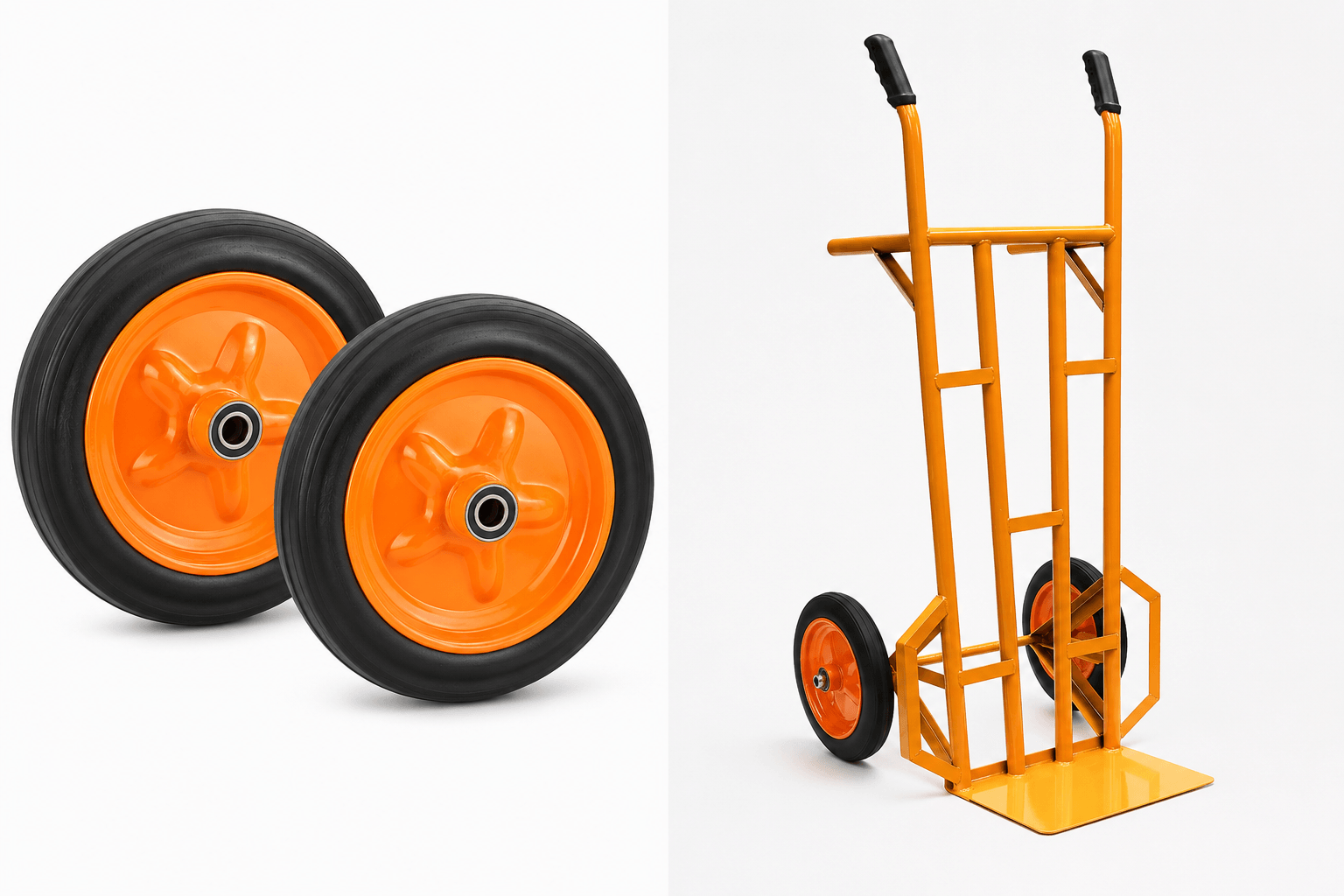
Flat tires and air leaks can interrupt daily material handling and increase maintenance time. For hand trolleys, warehouse carts and other frequently used equipment, choosing the right wheel can make a significant difference in reliability and operating efficiency.
Both solid rubber wheels and pneumatic wheels are widely used for material handling. However, they have different characteristics. Pneumatic wheels provide better cushioning, while solid rubber wheels eliminate the risk of punctures and require less routine maintenance.
So, which one is better for your application?
What Is a Solid Rubber Wheel?
A solid rubber wheel uses a solid rubber tire instead of an air-filled inner tube. Because there is no air inside the tire, it cannot go flat due to punctures or air leakage.
This makes solid rubber wheels particularly suitable for equipment that is used frequently and where reducing downtime is important.
Common applications include:
- Hand trolleys and hand trucks
- Warehouse carts
- Factory material handling equipment
- Logistics carts
- Industrial transport equipment
Why Choose Solid Rubber Wheels?
1. No Flat Tires
One of the main advantages of solid rubber wheels is puncture resistance.
In warehouses, workshops and construction environments, sharp objects, metal pieces or other debris may damage pneumatic tires. A solid rubber wheel has no inner tube, so punctures do not result in a flat tire.
2. No Inflation Required
Pneumatic tires need the correct air pressure to maintain their performance.
Solid rubber wheels require no inflation or regular tire-pressure checks. This makes daily maintenance simpler, especially when a business operates multiple hand trolleys or carts.
3. Low Maintenance
Air leakage, punctures and damaged inner tubes can require repair or replacement.
Solid rubber wheels eliminate these air-related problems and can therefore reduce routine wheel maintenance.
4. Reliable for Frequent Material Handling
For warehouses, factories and logistics operations where carts are used repeatedly throughout the day, reliability can be more important than maximum cushioning.
Solid rubber wheels provide stable everyday performance without the concern of unexpected flat tires.
Advantages of Pneumatic Wheels
Solid wheels are not automatically the best option for every application.
Pneumatic wheels contain compressed air, which gives them excellent cushioning and shock absorption. This can make them more comfortable to use on rough or uneven surfaces.
Their main advantages include:
- Better shock absorption
- Smoother movement over uneven surfaces
- Reduced vibration
- Better cushioning for sensitive loads
For outdoor transportation, rough ground or applications where shock absorption is especially important, pneumatic wheels may still be the better choice.
Solid Rubber Wheels vs Pneumatic Wheels
The choice depends on the actual working conditions.
| Feature | Solid Rubber Wheels | Pneumatic Wheels |
|---|---|---|
| Puncture Risk | No air-related punctures | Can be punctured |
| Inflation | Not required | Required |
| Maintenance | Low | Higher |
| Shock Absorption | Good | Excellent |
| Rough Surface Comfort | Good | Better |
| Daily Reliability | Excellent | Depends on tire condition |
| Typical Application | Hand trolleys, warehouse carts, factory equipment | Outdoor carts, uneven surfaces, applications requiring more cushioning |
Which Wheel Should You Choose?
Choose solid rubber wheels when your priorities are:
- Avoiding flat tires
- Reducing maintenance
- Frequent daily use
- Reliable operation
- Warehouse or factory material handling
Choose pneumatic wheels when your priorities are:
- Maximum cushioning
- Better shock absorption
- Frequent use on rough or uneven ground
- Reducing vibration during transportation
There is no single wheel that is best for every application. The correct choice depends on the load, road conditions, operating frequency and required level of cushioning.
Solid Rubber Wheels for Hand Trolleys
Hand trolleys are one of the most common applications for solid rubber wheels.
They are frequently used to transport cartons, tools, equipment and other goods in warehouses, factories and logistics operations. In these environments, an unexpected flat tire can stop the trolley from being used until the tire is repaired or replaced.
Using a solid rubber wheel removes this particular problem and makes the trolley easier to maintain.
For businesses that value reliability, low maintenance and frequent daily operation, solid rubber wheels can be a practical alternative to pneumatic wheels.
Conclusion
Solid rubber wheels and pneumatic wheels each have their own advantages.
Pneumatic wheels provide excellent cushioning and are well suited to rough surfaces. Solid rubber wheels provide a puncture-free, low-maintenance solution for hand trolleys, warehouse carts and industrial material handling equipment.
Instead of simply choosing one wheel material over another, consider the actual load, surface conditions and operating environment before making a decision.
YiDu Industrial manufactures solid rubber wheels, caster wheels and material handling products for different applications. Contact us if you need help selecting the right wheel size and type for your equipment.